


You can install seat covers for heated seats safely if the cover is airbag-compatible, thin enough to let heat pass through, and secured without pinching wires under the cushion. The short version: turn the car off, inspect the seat, avoid side-airbag seams and sensor areas, fasten straps loosely at first, then test heat on low before driving.
Seat Covers for Heated Seats
Choose a cover marked compatible with heated seats and seat-mounted side airbags.
Turn the vehicle off and let the seat cool.
Find the heating controls, wiring, side-airbag labels, seatbelt buckle, and seat adjustment rails.
Fit the backrest first, then the cushion.
Route straps around metal seat frame points, never around wires.
Test low heat for 10 minutes.
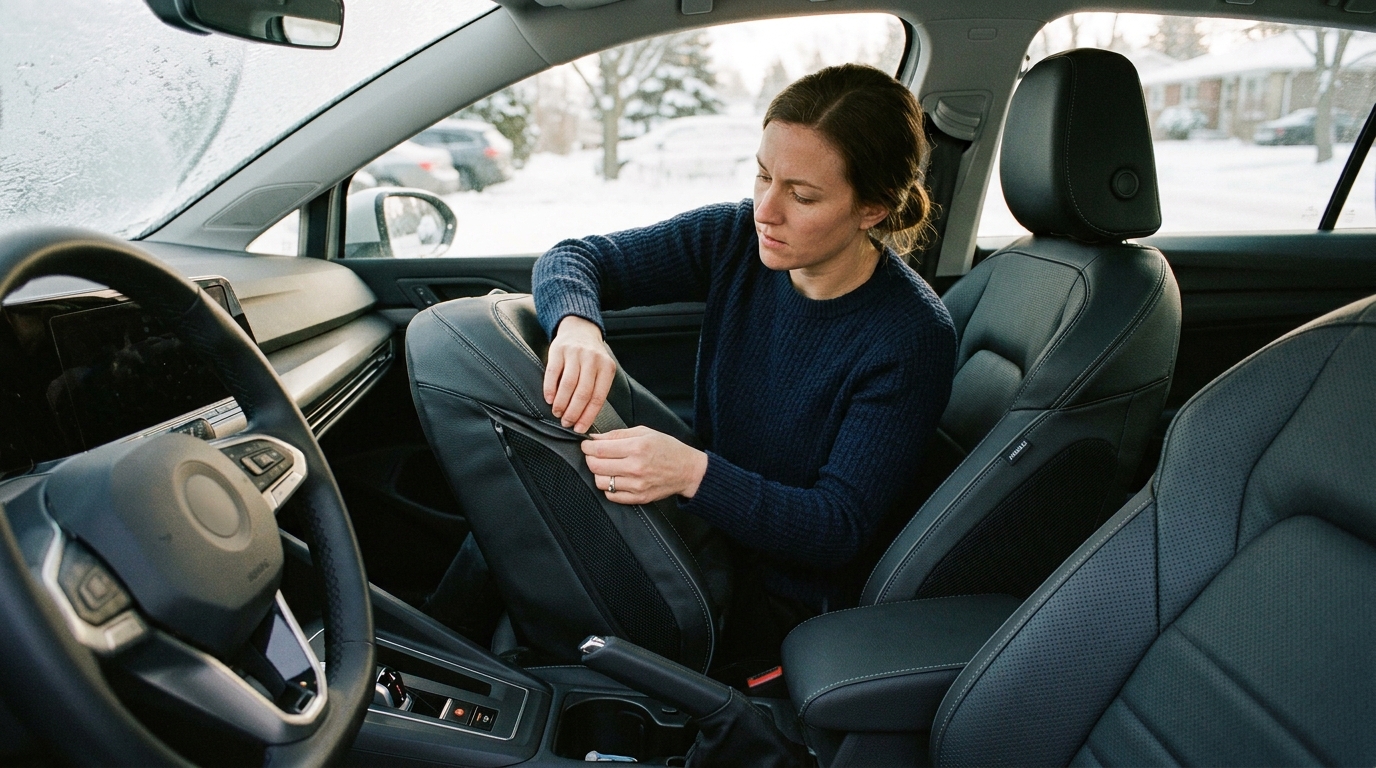
That 6-step check matters more than the cover material alone. A thick foam-backed cover can slow heat transfer even if it technically “fits,” while a thinner leatherette, mesh, or fabric cover usually warms faster. In cold places like Minnesota or Michigan, that difference is obvious: the seat either feels warm by the time you reach the highway, or it still feels like a cold bench.
The bigger safety issue is the side airbag, not the heater. Many modern vehicles, including the 2019-2026 Toyota RAV4, 2021-2026 Ford F-150, 2020-2026 Honda CR-V, and 2022-2026 Hyundai Tucson, can place side airbags in the outer edge of the front seatback. The National Highway Traffic Safety Administration explains that side airbags work with seat belts to reduce injury risk in crashes, so a cover that blocks a seat seam or airbag path is the wrong cover, even if it looks perfect on day one. Source: NHTSA air bag safety.
Here’s the filter we use before installation:
| Seat feature | What to check | Safer choice |
|---|---|---|
| Heated cushion | Heating area under seat bottom and backrest | Medium-thin cover with no dense foam pad |
| Side airbag | “SRS Airbag” tag on outer seatback | Airbag-compatible side opening or breakaway seam |
| Power seat | Moving tracks and motors under seat | Straps kept above rails and away from gears |
| Occupant sensor | Passenger cushion sensor | No hard clips pressing into the cushion |
| Seatbelt buckle | Buckle stalk and pretensioner area | Cover cutout that doesn't trap the buckle |
Coverado customers often tell us the real install time is under 30 minutes for the front row when the cover is laid out first and the straps are separated before starting. That sounds small. It isn't. Most bad installs begin with someone half-sitting in the doorway, one strap twisted under the seat, and the passenger sensor wire right where a hook is about to land.
If you’re replacing worn covers across the cabin, browse Coverado’s car accessories after you know your seat type, trim, and airbag layout. Fit comes before style here.
Heated Seat Safety Check
Before you touch a strap, sit in the driver’s seat and look for four labels: SRS Airbag, seat heater switch, seatbelt anchor, and power-seat control. On a 2024 Honda Accord EX-L, for example, the heated seat switch sits in the center control area, while the side-airbag label is stitched into the outer seatback. Those two systems are separate, but your cover touches both zones.
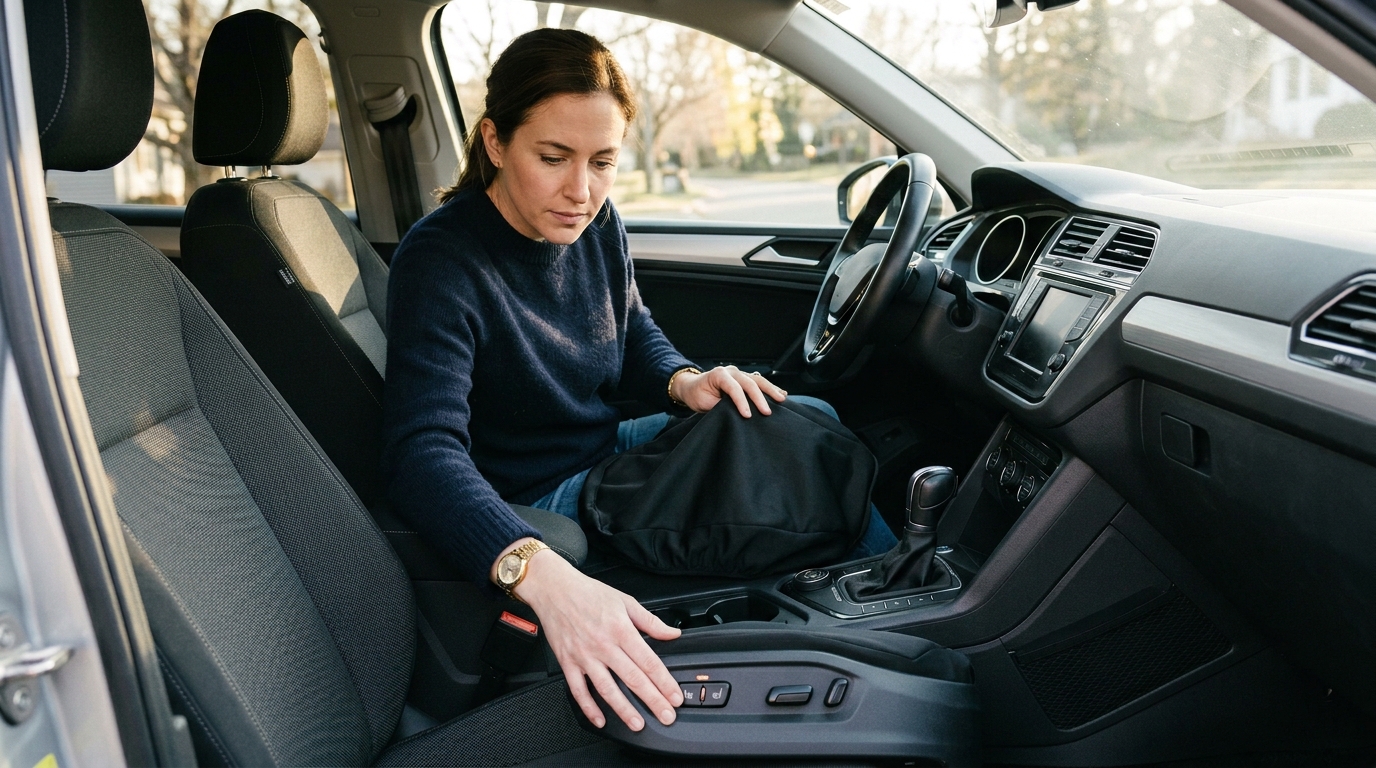
Turn the ignition off. If your vehicle has memory seats, slide the seat all the way back and raise it to its highest position before fitting the cover. That gives your hands room under the cushion and keeps you from dragging straps across wiring. Don’t disconnect seat wiring unless the vehicle service manual tells you to. Unplugging the wrong connector can trigger an airbag warning light, and clearing that light may require a scan tool.
A quick flashlight check saves time:
- Look under the seat for yellow, orange, or bright-wrapped connectors; these often mark restraint wiring.
- Keep hooks and elastic cords away from moving seat tracks.
- Don’t run straps over the seatbelt buckle cable.
- Don’t cover a plastic airbag tag or stitched tear seam on the outer side bolster.
- Don’t add extra foam, towels, or pads between the heated seat and the cover.
Federal Motor Vehicle Safety Standard No. 302 covers burn resistance requirements for materials used in occupant compartments. The NHTSA test procedure says covered interior materials must meet burn-resistance requirements when they’re close to the cabin air space. Source: NHTSA FMVSS 302 laboratory procedure. That doesn't mean every aftermarket cover is tested the same way your factory seat was. It means you should avoid mystery materials, loose padding, and cheap adhesive-backed heater pads that have no clear product information.
One more thing people miss: ventilation. If your vehicle has heated and ventilated seats, such as a 2023 Ford Explorer Limited, 2024 Kia Telluride SX, or 2025 Toyota Camry XLE, a waterproof neoprene-style cover may protect the seat but reduce airflow. It can still be a good choice for dogs, work trucks, or snow gear. For daily comfort, perforated leatherette or breathable fabric works better.
Best Cover Materials
Leather seat covers look clean and are easy to wipe down, but genuine thick leather can slow heat. That’s why custom leather covers need careful fit around the bolsters and cushion. A high-grade leatherette cover often warms faster than thick leather because the material can be thinner and more even. For heated seats, thickness and backing matter more than the label on the box.

Fabric covers are the quick-heat option. A woven polyester or jacquard surface usually lets warmth reach your body sooner, and it grips well when you climb in wearing a winter coat. The drawback is cleanup. Coffee, sunscreen, and road-trip snacks are less forgiving on fabric unless the cover has a stain-resistant finish.
Here’s how the main materials compare for heated seats:
| Cover material | Heat transfer | Cleaning | Best use case |
|---|---|---|---|
| Thin leatherette | Fast to medium | Easy wipe-down | Daily commuters, families |
| Perforated leatherette | Fast | Easy wipe-down | Heated and ventilated seats |
| Woven fabric | Fast | Needs more care | Cold climates, low slip |
| Thick genuine leather | Medium to slow | Good long-term care needed | Luxury cabins, custom fit |
| Neoprene-style cover | Slow | Very easy | Work trucks, pets, wet gear |
If you’re choosing between two covers and both fit your vehicle, pick the one with better side-airbag compatibility and less cushion thickness. A soft, thinner cover that stays in place is usually better for heated seats than a plush cover that traps warmth underneath. Comfort has a ceiling; trapped heat has consequences.
This is where Coverado’s design process matters. Our in-house design team updates styles weekly, but the fit still has to respect the seat hardware first. A black-and-cognac set for a 2022 Nissan Rogue should not install like a loose blanket. A sport-style cover for a 2021 Dodge Charger should not bind against the side bolster. Style gets the click; fit earns the repeat drive.
If your factory heaters are weak or your base trim never came with them, compare purpose-built car seat heaters instead of stacking a thick heated cushion on top of a fitted cover. A separate heater can be useful, but only when the wiring, switch location, and fuse load are handled correctly.
Installation Without Damage
Start with the backrest. Remove the headrest, slide the cover over the top of the seatback, and align any airbag-safe side opening with the outer bolster. Pull evenly from both lower corners. Don’t yank from the center panel; that stretches the surface and can pull stitching off-line.

Next, tuck the lower flap through the seat gap between the backrest and cushion. This is the part that makes people impatient. On vehicles like the 2020-2026 Toyota Highlander and 2021-2026 Chevrolet Tahoe, the gap can feel tight because the cushion is thick and the seatback angle is steep. Use your fingers, not a screwdriver. A plastic trim tool is fine if it has a rounded edge.
Then fit the seat bottom. Center the cushion panel first. Make sure the front lip reaches the lower edge of the seat without covering power switches. If the cover has side skirts, smooth them around the cushion without trapping the seatbelt buckle. The buckle must return to its normal angle after you release it.
Use this strap order:
Front straps under the seat front, above the rail path.
Rear straps through the seat gap, pulled gently.
Side straps around fixed metal frame points.
Final tension only after the seat can move forward, backward, up, and down.
Never hook a strap to a wire loom. Never cross a strap through a yellow connector. Never tie a strap around the seat track because the track moves with force; if it catches, it can tear the cover or damage the seat motor. On manual seats, slide the seat through its full range after install. On power seats, move slowly and listen for rubbing.
Now test the heat.
Turn the vehicle on, set the heated seat to low, and wait 10 minutes. The cover should warm gradually. If one spot becomes hot while the rest stays cold, shut it off and remove the cover. Uneven heat can mean the cover is folded under pressure, a strap is compressing one area, or the original seat heater has a fault that the cover made easier to notice.
After low heat passes, try medium for another 5 minutes. High heat is usually for warm-up, not long drives. In a 2018 Subaru Outback or 2023 Mazda CX-5, the highest setting can feel too warm once the cabin heater catches up. If your cover traps heat, drop to low sooner.
A proper install feels boring afterward. The cover doesn't slide when you brake. The seatbelt clicks without wrestling. The heater feels slower than bare upholstery by a few minutes, but not blocked. That’s the target.
Common Installation Mistakes
The first mistake is buying by “universal” alone. Universal covers can work on simple bucket seats, but heated power seats with side airbags need more care. A 2016 Toyota Corolla LE and a 2024 Ford F-150 Lariat do not ask the same thing from a cover. The truck seat is wider, the bolsters differ, the wiring underneath is busier, and the trim may have heating, ventilation, lumbar, memory, and seatbelt reminders in the same area.

The second mistake is adding layers. People put a heated cushion over a seat cover over a heated seat because one part of the old heater feels weak. That stack is uncomfortable and hard to anchor. It also creates confusing heat behavior: the factory heater warms from below, the plug-in pad warms from above, and your body is stuck between two systems. Fix the weak heater or choose one heating source.
Third: blocking seat airbags with a full-wrap side panel. If your cover has a solid side panel over the outer seatback and your seat has an SRS airbag tag there, stop. The cover may fit the shape, but it doesn't fit the safety system. Airbag-compatible covers usually use a breakaway seam, side opening, or tested construction that leaves the deployment path clear.
Fourth: overtightening. Tight straps look tidy at first. Then the seat moves, the elastic stretches, and a hook shifts into a wire. Snug is enough. You should be able to slide two fingers under most elastic straps after the final fit check.
Fifth: ignoring passenger-seat sensors. Many vehicles use an occupant classification sensor in the passenger seat cushion to help decide airbag behavior. A cover that bunches under the cushion, hard plastic clips pressing into the pad, or a thick accessory cushion can confuse the system. If the passenger airbag light acts differently after installation, remove the cover and inspect the fit before driving with a passenger.
Use this fast trouble table:
| Problem after install | Likely cause | Fix |
|---|---|---|
| Seat heats slowly | Cover too thick or non-breathable | Use thinner heated-seat-compatible cover |
| One hot spot | Folded cover or compressed heater zone | Remove, smooth, reinstall |
| Airbag tag hidden | Wrong side-panel design | Use airbag-compatible cover |
| Seat won't move fully | Strap in track path | Re-route around fixed frame |
| Passenger airbag light changes | Sensor pressure or bunched cushion | Remove cover and check fit |
If you want a deeper walkthrough for standard front-row installs, this guide on how to install seat covers pairs well with the heated-seat checks above.
Fit by Vehicle Type
A compact sedan usually gives you the easiest install. A 2022 Honda Civic EX or 2021 Toyota Corolla XSE has front seats with clear cushion edges and manageable under-seat access. Heated-seat wiring is present on higher trims, but there’s usually less hardware than in a full-size SUV. Expect 20 to 30 minutes for the first front seat if you move slowly.

Pickup trucks are different. A 2024 Ford F-150 Lariat, 2023 Chevrolet Silverado 1500 LTZ, or 2022 Ram 1500 Big Horn may have wide seats, deeper bolsters, power lumbar, seat memory, rear storage pockets, and heated rear seats depending on trim. The install isn't hard, but access under the seat can be crowded. Put the seat all the way up before starting, and check the rear seat floor area after tightening straps.
Three-row SUVs add another concern: folding action. In a 2023 Kia Telluride, 2024 Hyundai Palisade, or 2022 Toyota Highlander, second-row captain’s chairs may slide, recline, fold, and tilt for third-row entry. Any cover strap that blocks that movement will get punished fast. Test every fold and slide motion before calling the job done.
Luxury vehicles need the most restraint. A 2020 Lexus RX 350, 2023 BMW X5, or 2024 Mercedes-Benz GLE can include heated, ventilated, massaging, and sensor-heavy seats. A basic slip-on cover may protect the upholstery but reduce the features you paid for. For these vehicles, choose covers that leave controls, perforations, side panels, and seatback pockets accessible. If the vehicle manual warns against aftermarket covers for that seat type, follow the manual.
There are cases where seat covers for heated seats are the wrong move. Don’t install a cover if the seat heater already smells hot, the upholstery is wet from a leak, the airbag warning light is on, the seat has exposed wiring, or the cover seller can’t confirm side-airbag compatibility. Those are repair problems, not accessory problems.
FAQ
Can covers block heated seats?
Yes, thick covers can slow heat or make it feel uneven. Choose thinner, heated-seat-compatible covers and test low heat for 10 minutes after installation.
Are seat covers airbag safe?
Only if the cover is made for seat-mounted side airbags. Look for an airbag-safe seam, side opening, or vehicle-specific fit that keeps the SRS deployment area clear.
Do heated seats damage leatherette?
Normal factory heated seats shouldn't damage quality leatherette when used as intended. Avoid extra heater pads, high heat for long periods, and covers with unknown backing materials.
Why is one spot hotter?
A hot spot usually means the cover is folded, compressed, or too thick in one area. Turn the heater off, remove the cover, smooth it out, and reinstall.
How long should install take?
Most front-row installs take 20 to 30 minutes when the covers fit correctly. Power seats, trucks, and three-row SUVs can take longer because under-seat routing needs more care.
Coverado seat covers are made for drivers who want protection without giving up the factory features they use every week. Choose the right fit, keep the heater and airbag paths clear, and use Coverado’s 30-day free returns, free shipping, and 18-month warranty to get the cabin right before winter does the testing for you.